
Research Loop
Praxist turns one external task project into successive generations of candidate implementations and measured evidence. Core does not compile a task prompt into code: peers inspect the baseline, implement hypotheses, run the task-owned evaluator, and publish evidence. Praxist coordinates that work and commits what later generations may inherit.
Principal Investigator (PI) agents propose next-generation work; multi-PI topologies add a Chair that consolidates those proposals. The Glossary gives compact definitions, while Panel Topology Prompts owns the panel contract.
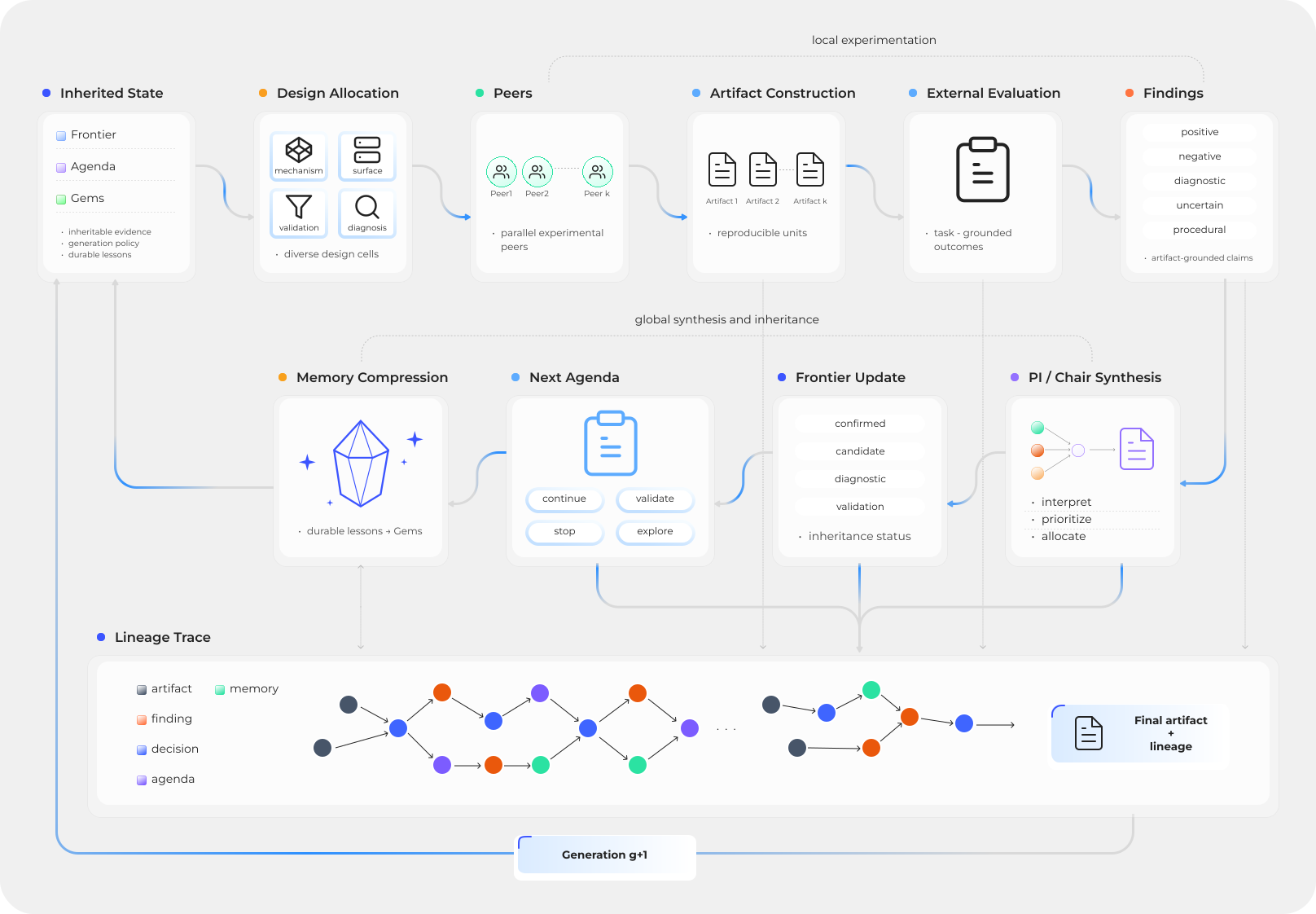
Local experimentation becomes global evidence and a committed plan for the next generation.
1. Resolve and Freeze the Run
Startup resolves the selected task, plugins, prompts, baseline references, API provider, agent runtime, and initial durable state. It writes a run-local frozen configuration before cohort execution. The task schema and precedence rules are defined in Task Projects; the research loop consumes that contract without adding domain meaning.
2. Build the Generation Context
GenerationLoop combines:
- the task prompt, peer role, and allowed work surface;
- the committed agenda and optional Deep Innovation Gate (DIG) or Quality-Diversity (QD) allocation;
- compact frontier, incubator, Gems, graph, and negative-evidence views;
- peer-local research memory; and
- the task-owned evaluator and protocol contract.
Generation zero starts from the baseline and initial task context. DIG may run once before its cohort when enabled; QD is independently selectable. Later generations use the preceding committed PI/Chair agenda. DIG is normally off, while QD can allocate candidate contracts through the existing synthesis path. Deep Innovation Gate and Quality-Diversity Allocation own those mechanisms.
The workflow records gen_N/research_topology.json so worker identities,
declared inputs/outputs, and visibility policy remain auditable without changing
peer semantics.
3. Execute Peer Work
Each peer receives a rendered prompt and a normalized runtime request. A typical peer:
- reads its task, role, agenda, and inherited evidence;
- states a mechanism hypothesis and intended evidence stage;
- creates an independent variant under
variants/; - changes only permitted files;
- submits evaluation through the task's public evaluator path;
- writes structured output under
results/; and - publishes a finding with caveats and follow-up.
The selected resource policy controls experiment admission. It does not choose the hypothesis or change scientific validity. See Central Experiment Scheduler.
4. Materialize Evidence
A result summary answers what the evaluator measured. A finding records how later research may interpret and use that result. Praxist recursively discovers recognized summaries and idempotently materializes their usable metadata into canonical findings.
Findings preserve actual evidence stage, maturity ratios, metrics, mechanism, caveats, lane intent, parent eligibility, and follow-up. A repeated finding ID can refresh changed non-empty fields without erasing useful older fields omitted from the update.
Committed lane membership lives in
frontier/frontier_manifest.json. A leaderboard is only a derived view.
Task-owned lane, maturity, and Gems policy is defined in
Task Projects.
Immature scout or partial output
remains a validation signal, not incubator content.
Artifact-role definitions are owned by Architecture. The loop plans from canonical state, keeps useful validation signals visible, and never treats old prompts, reports, or evidence packs as current truth.
5. Close and Commit the Generation
After admitted work drains, the boundary performs one ordered commit:
- ingest peer findings and result summaries;
- run a final idempotent evidence refresh;
- update canonical finding, graph, frontier, incubator, and optional Gems state;
- refresh peer memory and negative-evidence summaries;
- build the PI evidence view and synthesize the next agenda; and
- write
gen_N/generation_boundary.json.
The marker is the completion fact. Results or frontier files without a contiguous marker are pending boundary work for resume to finish.
A recorded evidence cutoff makes retries deterministic. Results published after that cutoff remain visible as late validation signals, but cannot enter the closed generation through retry timing. Atomic files visible before the cutoff remain eligible even if ingestion observes them during reconciliation.
Research-Loop Flexibility Controls owns close eligibility, mature quorum, drain, and bounded-liveness behavior.
6. Synthesize and Inherit
PI/Chair synthesis reads committed evidence, prior agenda, task constraints,
memory, and diversity diagnostics. It writes the next agenda under
agendas/research_agenda_gen<N+1>.yaml.
An agenda assigns planned work; it is not measured evidence. Evaluator results and committed retention state continue to own scores, maturity, protocol status, and parent eligibility. A failed or uncommitted agenda cannot drive another cohort.
A later peer may restart from the baseline, inherit a durable candidate, repair a credible signal, ablate a strong result, combine compatible mechanisms, or investigate an anti-mainline direction. Praxist supplies evidence and constraints, not a fixed code-generation template.
7. Audit the Flow
| Question | Canonical location |
|---|---|
| What was implemented? | variants/<variant>/ |
| What was measured? | results/<variant>/ |
| What evidence was published? | findings/, shared_findings/, or the canonical finding store |
| What was durably retained? | frontier/ and gems/ |
| What did the panel plan next? | agendas/ |
| Did the generation commit? | gen_N/generation_boundary.json |
A variant present only under variants/ or results/ may not influence
later planning if no usable finding can be published or materialized.